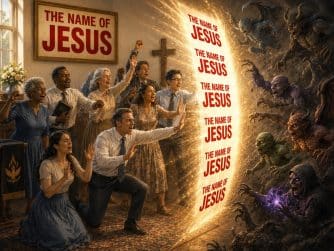



Not many preachers talk about sin anymore, instead we have ‘problems.’ Trouble is, problems can be solved, sin cannot. Only God can solve our sin issue and thankfully He did, via His Son’s precious blood sacrifice. Many preachers avoid the mention of ‘sin’ for fear of offending their congregants. This is a snare of the devil. A drowning man will not reach for a life-jacket if he remains oblivious to the urgency of his critical condition. But what exactly is humanity’s present condition and what does sin have to do with it? Join Carl now…
Here is a complete transcript of the broadcast (below)…
What is this thing called sin exactly, this spiritual force and death sentence which permeates through our bloodline? Why is it so destructive and yet at the same time, so elusive to humanity as a whole? This sin issue was so defining, God sent His only begotten son, incarnated in physical flesh, to be led to slaughter, via one of the most gruesome deaths ever devised…join me now, as we delve into the origin of sin and it’s severe repercussions.
In the Book of Genesis, God pronounced His creation as ‘very good’ but in spite of this proclamation, the prevalence of death, suffering, oppression, and wickedness all around us testifies of an experience which is far from ‘good.’ The presence of evil and the earth’s woes have perplexed the great thinkers and philosophers of this world for eons. The good news, is that God not only has the answer for our wretched condition, but a remedy for sin and its disdainful stain on humanity. The nature of sin is selfish firstly and wreaks of pride. The temptation of man can be found in Genesis chapter three, and I don’t have the time to read the passage in its entirety. What we find is that Genesis 3 is in direct opposition to evolutionary theory, which purports that man began at the bottom of the moral ladder and is working his way up, but this is a lie, because the true history of humanity is woeful, it’s a tale of man starting at the very top, in the image of God and then proceeding to tumble rapidly into the moral abyss.
Genesis three describes a forbidden tree being placed in the Garden of Eden, as a test of man’s free will. The mere presence of the tree of knowledge of good and evil, ultimately provides a test of character because for obedience to be esteemed, there must first be an opportunity to disobey, and the tree provided this opportunity. In order for Adam’s character to be proven, there had to be a test, because character is the sum total of our choices, and inevitably our character is defined, by our individual choices. This premise of free will carries through to the angelic realm, as the first transgression was instigated by a fallen cherub named Lucifer, a guardian of God’s glory. His rebellion can be found in Ezekiel chapter 28 and Isaiah 14. Check it out when you have time.
Sin, having it’s origin in the ancient past, propelled this serpentine angel to tempt our forefathers with the forbidden fruit. But for every transgression there must first be a breach in the will of that entity. Our will is the gatekeeper and our will is greatly influenced by what we meditate on in the mind, for it has always and will always be the battle ground of the spirit realm. We are thus admonished to guard our mind and meditate on scripture, on a regular basis. Ironically, when the serpent suggested Adam and Eve would become like God, by partaking of the fruit, he was baiting them with something already in their possession. You see, they were already like God and created in His image. They lacked nothing, enjoying daily fellowship with God. Instead of making them god-like, this fruit caused a severing in relationship, a miserable feeling of guilt, and consequently making them fearful of their benevolent creator. Their physical nakedness then became a picture of their guilty conscience.
Emotional disturbances are often reflected in our countenance and Adam and Eve sought to remedy their guilt with a fig leaf. Some commentators speculate that before the fall, Adam and Eve were clothed in a halo or garment of light, which was a sign of their communion with God and the dominance of the spirit man over their physical body. When they sinned this communion was broken, the body then overcame the spirit-man and thus the ever-present conflict between the spirit and flesh commenced. Not until Christ came, was this conflict resolved, via His immaculate reconciliation. It is interesting that light is a euphemism for holiness, as we are told to walk in the light of God’s Word, that God is light and in Him is there no darkness at all, so on and so forth. Man yearns to return to the eminence of Gods light but of course the false cults of this world offer a false light of illumination instead, holding to a path of salvation through knowledge instead of saving grace through faith.
As a result of sin, insecurity, shame, and inferiority, were bequeathed to our forefathers through their transgression. You see the instinct of guilty men is to flee from God. As Adam and Eve hid in the trees to hide their shame, likewise people today try to hide their separation from God in pleasures and activities. The fig leaf was man’s attempt to cover his guilt with a garment of excuses or forgetfulness but only a ‘God made’ garment of animal skin would be sufficient to absolve their guilt. This of course was a typology of the savior to come. Because of sin, man brought evil upon himself and it gained entrance into the tapestry of creation and we have been reeling ever since. Man’s image, originally created in God’s image became marred and humanity has struggled with an identity crisis ever since. The moral condition of our soul then became severely handicapped as Adam passed on a tendency or bias for sin, in future generations. You see, all have sinned, all are under a curse, the natural man is stranger to the things of God, our hearts became deceitful and wicked, our mental and moral nature became corrupt, our carnal mind became hostile to God, we became slaves to sin, controlled by the prince of the power of the air, dead in trespasses and a child of wrath. If you don’t think sin is a big deal, think again. It is destructive, deceitful, and deadly.
Genesis three reveals, that man was cursed, the woman was cursed, the serpent was cursed and the ground was cursed. So begins our existence in the place called earth, owned by God but leased to the serpent through Adam’s transgression, Satan, sadly became the ruler, prince and god of this world. Hence wars, pestilence, destruction, disease, entropy, decay, and even old age, became the trappings of sin and the very the canvas of our existence. A far cry from God’s original intent, yet we chose this path and God is not to blame.
Lest we forget the earth is cursed also, the very source of earthquakes, hurricanes, tornadoes, mudslides, drought, so on and so forth. In some mysterious fashion the earth and creation have shared the curse and fall of man, for man and land are inexorably linked, in both fruitfulness and barrenness but one day man and land will share in total redemption, during the millennial reign of Christ. But how exactly do we define sin? A study of sin in the original Hebrew and Greek will yield the scriptural definition of sin. The most commonly used word for sin (chatta), conveys the notion of ‘missing the mark,’ like an erratic archer who shoots but misses, so humanity in like manner misses the true aim of existence. For the most part this word represents a sin against God (Lev. 4:14). Men are to return from “sin,” which is a path, a life-style, or act deviating from that which God has marked out (1 Kings 8:35). They should depart from “sin” (2 Kings 10:31), be concerned about it (Ps. 38:18), and confess it (Num. 5:7). Sin is a big deal, even if modern man chooses to avoid its stench.
Sin is something we must live with and manage on an ongoing basis, albeit our original Adamic sin is forgiven and nullified by Christ’s precious blood, it still crouches at the door like a wild animal ready to pounce. While it is true that men are sinners because they sin, it is a fundamental principle that men sin because they are sinners. They were sinners by nature before they became sinners by practice. Another word for sin, means ‘crooked or perverse,’ it is the opposite to righteousness and the conduct of a believer. And finally, sin equates to evil, an evil denoted by man’s failure to obey God, breaking God’s laws in the process. Other words describing sin stress the deceitful and vain element of sin. The first sinner was a liar (Jn 8:44); the first sin began with a lie (Gen 3:4); and sin always contains an element of deceitfulness. You see man was created Holy in God’s sight, the entire Israelite nation were a kingdom of priests, each member being in touch with God. Every Israelite was Holy and set apart for God. This motif was carried through to the Gentiles as they were seconded into the main vine of the husbandmen, thank God.
The devil is sneaky and his stratagems seductive. Yet through discipline, diligence, and some good old fashioned will-power, in tandem with God’s Grace, we can live a lifestyle of holiness and minimize our fleshly inclinations toward sin. The New Testament describes sin as missing the mark, a debt owed to God which we cannot pay, lawlessness which exists in the very fiber of our being, a tendency toward disobedience, a transgression or going beyond the limits God has set for us, a fall from Grace or the standard which God has set, a defeat exhibited by Israel in particular, having rejected Christ, ungodliness expressed by a lack of worship or reverence for our Heavenly Father, and finally an error of presumption.
As Dorothy Sayers, the English novelist and playwright once observed, “In the world sin is called Tolerance, but in hell it’s called Despair.” This despair is the visceral emotion one feels without God because Sayers went on to state, “that sin in essence, believes in nothing, cares for nothing, seeks to know nothing, interferes with nothing, enjoys nothing, hates nothing, finds purpose in nothing, lives for nothing, and remains alive because there is nothing for which it will die.” Sin breeds death in every facet of our earthly experience and leads to a futile existence.
So, what did Christ do on the cross, he reconciled us to our heavenly father, with whom we were at enmity. Christ made it so that we had never sinned. He made our spirit man, anew, born again from death to life. Our Reconciliation in a theological sense, refers to the change of relationship between God and man. We are naturally children of wrath (Eph. 2:3), and are at enmity with God (Eph. 2:11–15); but, “…we were reconciled to God through the death of His Son…” (Rom. 5:10). Because of the death of Jesus, our relationship with God is changed for the better. We are now able to have fellowship with Him (1 John 1:3). The problem of sin that separated us from God (Isaiah 59:2) has now been removed by the cross and it was accomplished by God in Christ (2 Cor. 5:18). All we need to do now is partake of His sacrifice and believe on Him. I often chuckle at people who are unsure of whether God loves them, but when we consider the torture Christ experienced up to his dying breath, that notion should never cross our minds, albeit, perhaps this short illustration will bring clarity to this predicament.
Friend, the price Jesus paid for our redemption was terrible indeed. When we think of the extreme suffering He endured to purchase our freedom from sin’s penalty, our hearts should overflow with love for Him. Leslie B. Flynn told a story that illustrates this truth. “An orphaned boy was living with his grandmother when their house caught fire. The grandmother, trying to get upstairs to rescue the boy, perished in the flames. The boy’s cries for help were finally answered by a man who climbed an iron drainpipe and came back down with the boy hanging tightly to his neck.
Several weeks later, a public hearing was held to determine who would receive custody of the child. A farmer, a teacher, and the town’s wealthiest citizen all gave the reasons they felt they should be chosen to give the boy a home. But as they talked, the lad’s eyes remained focused on the floor. Then a stranger walked to the front and slowly took his hands from his pockets, revealing severe scars on them. As the crowd gasped, the boy cried out in recognition. This was the man who had saved his life. His hands had been burned when he climbed the hot pipe. With a leap the boy threw his arms around the man’s neck and held on for dear life. The other men silently walked away, leaving the boy and his rescuer alone. Those marred hands had settled the issue.” And friend, Christs’ pierced hands have settled the eternal issue. We may never fully comprehend with our finite minds the enormity of our sin and its far-reaching consequences. The good news, is God has delivered you from your wage of sin, your debt is already paid. All you have to do is repent, and freely receive of the gift of His precious blood by believing on Christ, it’s that simple. Do not delay, for there is no promise of tomorrow.
https://carljosephministries.com/why-do-christians-sin-lions-unchained-bible-study-1/
https://billygraham.org/articles/billy-grahams-answer-what-is-sin-are-all-sins-equal-in-gods-eyes
Title: What is Sin?
Bibliography:
W. E. Vine, Merrill F. Unger, and William White Jr., Vine’s Complete Expository Dictionary of Old and New Testament Words (Nashville, TN: T. Nelson, 1996), 232.
Galaxie Software, 10,000 Sermon Illustrations (Biblical Studies Press, 2002).
Knowing the Doctrines of the Bible: Myer Pearlman (Gospel Publishing House, Springfield, MO)
Foundations of Pentecostal Theology: Guy Duffield and Nathaniel M. Van Cleave (Foursquare Media).
Related keyword Searches:
What is sin
Is sin a force
Is sin spiritual
The consequences of sin
Reconciliation
Does Christ offer reconciliation
Enmity with God
Is man cursed
Is the earth cursed
Consequences of sin
Six Frequently Asked Questions:
1. What is sin according to the Bible?
Sin is missing the mark—failing to live up to God’s standards and breaking His laws. It is a spiritual condition rooted in rebellion against God, selfishness, pride, and deceit. Sin separates humanity from God and leads to death, both physically and spiritually.
2. Why don’t many preachers talk about sin nowadays?
Many avoid the topic of sin to prevent offending their congregants, focusing instead on “problems.” However, sin is not just a problem; it is a fundamental spiritual issue that only God can solve through Jesus Christ’s sacrifice. Ignoring sin leaves people unaware of their true spiritual condition.
3. Where did sin originate?
Sin began with the rebellion of Lucifer, a fallen angel, and entered humanity through Adam and Eve’s disobedience in the Garden of Eden. God gave mankind free will, and choosing to disobey Him introduced sin, guilt, and separation from God into the world.
4. How does sin affect humanity and the world?
Sin brought death, suffering, shame, guilt, and moral corruption to humanity. It also cursed the earth, causing natural disasters and decay. Sin enslaves people, making them hostile toward God and causing them to seek false sources of satisfaction.
5. Can sin be forgiven and overcome?
Yes. Through Jesus Christ’s sacrificial death and resurrection, the penalty of sin has been paid, by His precious blood, the object of our faith. By believing in Him and repenting, we are reconciled to God and given new spiritual life. Although believers may still struggle with sin after salvation, God’s grace enables us to live in holiness and resist sin’s power (1st Jn 1:8).
6. Why is sin so deceptive and dangerous?
Sin often begins with a lie and deceives people into thinking they can live apart from God or that they deserve something more than what God has provided. It is destructive because it breaks relationships, destroys souls, and leads to eternal separation from God unless forgiven through Christ.
Carl is an authority. He is a biblical scholar, minister, author, husband, father, and life coach. In his mid-twenties he had a powerful encounter with God and saw miraculous healings as a result. Carl is a unique researcher who investigates current affairs, societal trends, prophecy, technology, cults, and end time events, all through a biblical lens.
Carl holds a Doctorate in Theology (Th D). His Alma Mata includes: Salford University, Manchester, UK, Imperial College of Science, Technology and Medicine, London, UK, Rhema Bible Training College (Tulsa), and Southwestern Christian University (Oklahoma City).
Carl Joseph Ministries empowers believers in Christ to fulfill their God given potential. Join Carl every other Monday on the Lions Unchained Podcast, available on Spotify, iTunes and other mainstream platforms.
He currently resides in Colorado, with his lovely wife Amy, and their three children.