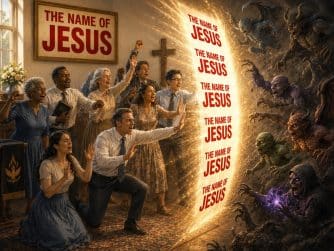



After Jesus ascended to heaven, John became one of the principal figures of the Church, along with Peter and James. Few realize, the Apostle John later served as Pastor of the church at Ephesus for many years. This ancient Greek City housed the ancient temple of Artemis (pagan mother goddess), one of the seven ancient wonders of the world. It is within this backdrop, we explore the 1st Epistle of John, who warned the early church of the dire threat of Gnosticism and the ‘hyper-grace’ movement (Nicolaitans), which still pose a menace to believers today. Join Carl now, for his enthralling expositional commentary…
Here is a complete transcript of the broadcast (below)…
As we begin a new year, we’re going to study First John, the epistle. I’m not talking about John’s gospel, but the first epistle of John, and there’s three in total. And now this letter is one of the most fascinating and powerful in the Bible, friends. It’s one of my personal favorites. And of course, scholars believe that John wrote it, all right, that’s the disciple whom the Lord loved. Because John’s not actually mentioned in the text, but there’s a lot of commonalities between John’s gospel and this epistle. For example, both mentioned the word light, right, and then we have darkness and life and word repeated over and over in both John’s gospel and the three epistles written by John, as many scholars attest. But John was the son of Zebedee and brother of James, and of course John was called the disciple whom Jesus loved. The Apostle John is usually seen as the author, therefore, of these books. But who was John the Apostle exactly? Well, like I said, John’s brother was James, and together they were called the Sons of Thunder by Jesus himself in Mark 3:17. John’s mother was Salome, who served Jesus in Galilee, and later witnessed his crucifixion in Mark 15. Now, few realize, of course, that the Apostle John was actually a follower of John the Baptist, and he was about 25 years of age when Christ called him to be a follower. But John, of course, has been traditionally claimed to have written the three epistles, John’s gospel, and of course the book of Revelation.
After Jesus ascended to heaven, John became one of the principal figures of the Church at Jerusalem, along with Peter and James, and you can read about that in Acts chapter 3, Acts 8:14, and Galatians 2:9. John was second only to the Apostle Paul in the number of books written that are included in the New Testament canon. So, John was a very important Apostle, and he served also as the pastor of the Church at Ephesus, and not many people realize that. However, the Emperor Domitian later exiled him to Patmos, which is an island just off Turkey, where he wrote the book of Revelation, and most interpreters have concluded that John was the last of the four gospels to be written, most likely between AD 60 and AD 95. Now, John’s gospel focuses on the nature of Jesus Christ, really about who he was, incarnate God on earth. Many other gospels, the Marks, the Lukes, etc., document details, specific healings, and accounts, and they are very treasured, but John goes almost a step further in the sense that he really focuses on the nature and character of Christ, being Christ beloved, of course, a description he gave himself. Many scholars also believe that John’s epistle, the first one in particular, was a rebuttal against Gnostics at the time, who didn’t conceive or believe, rather, that Jesus came in the flesh, that he was abstract, and that a God would never lower himself into our physical form.
But, friend, the Scriptures attest that this is a lie. The Word became flesh, as we shall find out shortly. No other book in the Bible has a prologue as overtly theological as does the Gospel of John, but this theme is carried through into the epistles of John. The purpose of the Word becoming flesh is to bring light into this world, and, friend, we are to walk in the light as Jesus did, and the epistle John talks about that. So let us read now from this very exciting book. Verse 1 of 1st John, “That which was from the beginning, which we have heard, which we have seen with our eyes, which we have looked upon, and our hands have handled, of the Word of Life.” Jesus came physically, friend, in opposition to the Gnostic claim that he was abstract and a spirit being only. For the life was manifested, and we have seen it, and bear witness, and show unto you that eternal life, which was with the Father, and was manifested unto us, that would be Jesus in physical form. That which we have seen, and heard, declare we unto you, that you also may have fellowship with us, and truly our fellowship is with the Father, and with his Son Jesus Christ, and these things write we unto you, that your joy may be full. Friend, joy in this lifetime is found in fellowshipping with the Father and his Son Jesus Christ, and guess what? Both of them dwell in you now. Not when you get to heaven. Greater is he that is in you, than he that is in this world. That’s 1st John 4:4, one we will read in the coming days.
Verse 5, “this then is the message which we have heard of him, and declared to you, that God is light, and in him is no darkness at all. If we say that we have fellowship with him, and walk in darkness, we lie, and do not the truth.” Now listen, we do not the truth when we’re hypocritical, in the sense that we’re not walking in fellowship with God, and with others. When we do so, and walk in love, we’re walking in the light. This is a metaphor for walking in love also. Verse 7, but if we walk in the light, as he is in the light, we have fellowship with one another, and the blood of Jesus Christ, his Son, cleanses us from all sin. So, there’s a condition here in verse 7, there’s a conjunction. The actual verse starts with a conjunction, but, right? Conditional. “If we walk in the light, as he is in the light, we will have fellowship with one another.” Notice, that fellowshipping with one another, that’s brethren, that’s Christians, is important to God. And then verse 8, a critical verse, “if we say that we have no sin, singular, we deceive ourselves, and the truth is not in us.” Now, this sin is the Adamic sin nature that everybody is born into.
If we do not acknowledge that sinful nature, we can never come to the cross. We can never admit that we have fallen short of God’s glory, as Romans 3:23 attests. We have to come to the realization that we are sinners, and once we do, if we sin after that, oh, there’s a propitiation for it. Verse 9, “if we confess our sins, he is faithful and just to forgive us our sins, and to cleanse us from all unrighteousness.” Friend, if you’ve sinned as a Christian, post-cross, the blood of Jesus still covers your sin, but it is a conditional election. In other words, you have to confess your sin, not to the priest, no, confess to your father, okay, confess your sins, and you will be forgiven and cleansed from all unrighteousness. Verse 10, if we say that we have not sinned, that’s pretty much ever, we make him a liar, and his word is not in us. In other words, if we claim that we’re not sinners, originally, by inheritance, through Adam, then we are actually claiming that God is a liar, and that’s, that’s just total nonsense, friend, amen. Now, verse 1 of chapter 2, “my little children, these things I write to you, that you sin not, and if any man sins, we have an advocate with the Father, Jesus Christ, the righteous, and he is the propitiation for our sins, and not for ours only, but also for the sins of the whole world.”
Friend, Jesus died for the entire world. The trouble is, the whole world doesn’t know it. Their sins are already paid for by Christ Jesus, yet they remain ignorant to this payment. We don’t have to conform to ascetism, which is a beating of the flesh, and a rigid fasting system, or trying to beat our flesh into submission. Yes, we decide to keep it under, as Paul instructed, but we don’t have to do things in a religious piety to try and advocate for ourselves, because the advocate is already here, Jesus Christ. He’s already made a way for us, amen? And so our sins are covered, we just need to confess them. Very important, all right? If you sin, you’re still in relationship with God, but there is a breaking of fellowship, and a temporary stage of unrighteousness. Otherwise, verse 9 would not say, confess your sin, and then be restored to righteousness, right? That’s what it says, you will be cleansed from all unrighteousness. And so when we sin, we are defiled temporarily, and our garments could be stained, and therefore they would be washed again in the blood, so the gown of salvation and the robe of righteousness are restored, amen? Now here’s the kicker in verse 3, “and hereby we do know that we know him, right, Jesus, if we keep his commandments.” Well, what are his commandments? They’re the ten commandments. Verse 4 says, “he that saith, I know him, and keeps not his commandments, is a liar, and the truth is not in him.“ In other words, there has to be some practice of what we preach.
If we really have gone from death to life, and we’re a new creation, a new creature in Christ Jesus, there should be evidence of that in the way we treat other people, right? In the way we love others, there should be some evidence of this change. And friend, keeping the Lord’s commandments is how we show that we love him, all right? And as I said, the ten commandments are still valid today, but in this passage they’re gonna be condensed into two, which is a repeat of the old, which Jesus said, love the Lord your God with all your heart, soul, and mind, and do unto others as you would have done unto you. This is pretty much the summation of the law and the prophets. In other words, love God and love people. Love God vertically, and you will love people laterally. Verse 5, “but whosoever keeps his word in him verily is the love of God perfected, hereby know that we are in him.”
He that says he abides in him ought himself also to walk as he walked. Again, John is challenging us to walk as Jesus did, in the light, in love, to show tangible fruit of this transformation experience from death into life as our spirit man became born again. Verse 7, “brethren, I write no new commandment unto you. Again, the Word of God is repeating, but an old commandment which you had heard from the beginning.” The old commandment is the Word which you have heard from the beginning. He says that twice in this verse, very important. Then again, “a new commandment I write to you, which thing is true in him and in you, because the darkness is past and the true light now shines.” Friend, the commandment is to love God and people, right? That is the commandment. That is evidence that you’re walking in this light.
Verse 9, “he that says he is in the light and hates his brother is in darkness even until now.” Again, we’ve switched from God, then we’ve gone laterally again, right? Remember back in verse 7 of chapter 1, the Apostle John talked about walking in the light, and then he referenced fellowshipping with one another. And again, here in verse 9 of chapter 2, a lateral reference that if you’re hating your brother, and remember that’s a brother in Christ because that’s what brother means in this context, If you’re hating a brother in Christ, then you’re walking in darkness. And that should be a challenge to us all, friend. The longer we harbor unforgiveness and hate and bitterness, the more we are gonna get wounded by it. It’s gonna stop the blessing over your life, and I urge you today, I implore you to let it go. Verse 10, he that loves his brother abides in the light, and there is no occasion of stumbling in him because he can clearly see his path, because the light is all around him. Verse 11, “but he that hates his brother is in darkness and walks in darkness and knows not where he goes, because that darkness blinds his eyes.”
Friend, are you walking in darkness today because you have been blinded by hate? I know this is a strong word. God has got an exciting future ahead for you as you walk in the light, amen? All right, that’s a sincere, encouraging word there. But we become spiritually blind and lacking discernment when we’ve allowed hate to overcome us, and that’s a word for someone out there right now, particularly pointed to a brother or sister in Christ, someone that you are still harboring resentment towards, and I urge you today to let it go. Friend, God is light, and in him is no darkness at all. Let there be no darkness in you either. If God is light, all knowledge and illumination and revelation comes from him, and because you’re attached to him and he lives inside of you, you’re gonna get some revelation yourself. Now, we have only gone to the second chapter of 1st John, verse 12, and I’m gonna pick it up again tomorrow. This is gonna be exciting, friend. It’s gonna change your life. Until tomorrow, good night, God bless, and remember to spread the good news.
https://carljosephministries.com/jesus-in-every-book-of-the-bible/
https://www.studylight.org/commentary/1-john.html
Title: Commentary on 1st John: Part 1
Related keyword searches:
Who are the sons of thunder
Who pastored the church of Ephesus
Did the apostle John visit Ephesus
Who was salome
Emperor Domitian
How to walk in the light
Where is Patmos
Who exiled John to Patmos
How do I walk in the light
Six Frequently Asked Questions:
1. Who was the Apostle John, and what role did he play in the early Church?
John was one of Jesus’ twelve disciples, known as the “disciple whom Jesus loved.” After Jesus’ ascension, John became a principal leader alongside Peter and James. He later served as the pastor of the church in Ephesus for many years and authored several New Testament books, including the Gospel of John, three epistles, and the book of Revelation.
2. Why is the city of Ephesus significant in John’s ministry?
Ephesus was an important ancient Greek city known for housing the temple of Artemis, one of the seven wonders of the ancient world. John served as the pastor of the Christian church there, ministering in a context heavily influenced by pagan worship and culture, which made his role in guiding the early believers especially challenging and critical.
3. What was the main message of the First Epistle of John?
The epistle primarily addresses the dangers of false teachings such as Gnosticism and the Nicolaitan ‘hyper-grace’ movement. John emphasizes that Jesus came in the flesh (opposing Gnostic denial of Jesus’ humanity), urges believers to walk in the light (love and truth), and highlights the importance of confessing sin and maintaining fellowship with God and other Christians.
4. How does First John describe the nature of Jesus Christ?
First John strongly asserts that Jesus Christ is the incarnate Word of God—God made flesh. This counters Gnostic teachings that denied Jesus’ physical incarnation. The epistle emphasizes Jesus’ tangible presence and life among the early believers as foundational to the Christian faith.
5. What practical guidance does John give for Christian living in his epistle?
John instructs believers to walk in the light by loving one another, confessing sins, obeying God’s commandments (summarized as loving God and others), and maintaining genuine fellowship with God and fellow Christians. He warns against hypocrisy, sin denial, and harboring hate, all of which lead to spiritual darkness.
6. Why is confession of sin important according to First John?
Confession is crucial because it restores broken fellowship with God. While believers are covered by the blood of Jesus, ongoing sin can temporarily defile them. Confessing sin allows believers to be forgiven and cleansed, maintaining their relationship with God and walking in righteousness.
Carl is an authority. He is a biblical scholar, minister, author, husband, father, and life coach. In his mid-twenties he had a powerful encounter with God and saw miraculous healings as a result. Carl is a unique researcher who investigates current affairs, societal trends, prophecy, technology, cults, and end time events, all through a biblical lens.
Carl holds a Doctorate in Theology (Th D). His Alma Mata includes: Salford University, Manchester, UK, Imperial College of Science, Technology and Medicine, London, UK, Rhema Bible Training College (Tulsa), and Southwestern Christian University (Oklahoma City).
Carl Joseph Ministries empowers believers in Christ to fulfill their God given potential. Join Carl every other Monday on the Lions Unchained Podcast, available on Spotify, iTunes and other mainstream platforms.
He currently resides in Colorado, with his lovely wife Amy, and their three children.