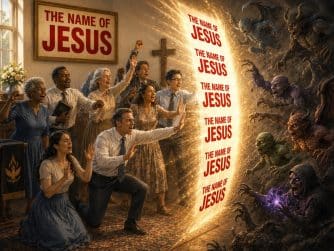



In this final session, Pastor Carl explores the sword of the Spirit—the living, powerful Word of God—and the importance of speaking Scripture in faith to overcome spiritual opposition. Discover how prayer, intercession, and supplication serve as powerful spiritual weapons, reaching beyond physical boundaries. Learn why maintaining intimate fellowship with the Heavenly Father is essential to keeping your spiritual armor effective. Join Carl now as we wrap up this exciting series from the book of Ephesians, where once, both the apostles John and Timothy served as pastors…
Here is a complete transcript of the broadcast (below)…
Friend, this is our third and final session on the whole armor of God.I hope you’re enjoying it. Let’s join us live now at D-Hop in session. The Word of God is double-edged. What does it have? It has mercy and judgment, mercy and judgment. Two sides. It has Logos, the written word, and it has Rhema, the spoken word. There’s two sides to the word, amen? This is the close combat weapon of choice, the most popular. Then there was the Pompeii sword, which is a little bit shorter. It had a primitive design. It wasn’t a tapered blade. See, this is straight-edged. This is tapered, all right? This was lighter and probably faster and more shiny, and that could put your enemy off as well. Even the reflection of blades have an impact. Then there was the Calvary sword. Then there was the Macarea sword, not the Macarena. That’s a whole other thing. This is the Macarea sword. The shorter blade, more like a dagger, all right, than a sword. But the Gladius Hispaniensis was made of iron.
It represents God’s Word, which is double-edged. Like I said, mercy and truth. But God’s Word is quick and powerful. If you look up that word, the word quick doesn’t mean fast. What does it mean? Alive. That’s what it means. So whenever you see that movie, The Quick and the Dead, it’s the alive and the dead, but it’s a play on words, right? One’s dead, one’s alive, and they’re alive because they’re quick, right? But God’s Word is quick, but it’s also alive and powerful, sharper than any two-edged sword. So what is the sword of the Spirit? What is it? It’s the Word of God, friends. And if we don’t know it, how are we going to go on the offensive? It’s great to have armor, but we need to be offensive as well, right? We don’t want to be there, you know, standing there with our armor going, great, everything’s great, I’ve got my armor on. Well, you need to fight back too, right? And this comes from knowing and speaking. The Logos is the written Word of God. The Rhema is the spoken Word of God.
A lot of people know the Logos, but very few people enter into the Rhema, which is speaking it over their life, speaking it over obstacles, speaking it over cancer, and any other disease that comes your way. If you want to see God move in your life, you’re going to have to act a little bit silly in the sense that Jesus spoke to obstacles, he spoke to trees, he spoke to the wind. We have to follow his design by speaking in faith the same way. Now, that’s a far-out word for some, but friend, unless you speak the Word of Faith over that person who is sick and do as the Word says in James 5, you will not see him healed, all right? There’s a part to play, right? Amen? We have a part to play. There is another weapon that is not spoken of in Ephesians 6, okay? And before I’m called a heretic, there is a long-range weapon that is prayer, okay? Now, this is another Roman soldier with a lance, he’d carry it, and this is another addition to the weaponry, which is a long-range metal tip and shank that is perfectly weighted to throw at distance. How many know that prayer is a weapon at distance? We don’t even have to be there, okay? We can just pray and things in Africa happen. We can just pray and things in Russia happen, all right? You know, there’s a story about Brother Kenneth Hagen in the early 1980s, before the Berlin Wall fell in 1989. They had some pastors come over from East Germany and the Eastern Bloc, Ukraine, behind the Iron Curtain. They came to one of their conferences in the early 80s, and they were, you know, they were down on themselves, and they’re like, look, we’re behind the Iron Curtain, everything is bleak there, etc. So what Brother Hagen said is, well, what are you doing right now in your prayers?
Well, we’re binding this, and then we’re binding that. He’s like, well, that’s good and all, but here’s what you need to do. You need to pray for your leaders. You need to pray that they have wisdom, because that’s what the Bible says, pray for leadership. It doesn’t say pray for them if they’re good or bad, it just says pray, right? So they turn their entire prayers from a negative prayer to Father God, with the Holy Spirit, touch those communist leaders for the gospel. Start giving them wisdom on how to make decisions Within five years of that conference, the Berlin Wall had fallen down. Now, is that a coincidence? I don’t personally think it’s a coincidence. We see the natural realm, and we see why communism failed, but friend, there was a spiritual battle occurring before the wall fell, amen? Years and years of people praying and pressing in, and friend, we need to do the same thing here in this country. There are people who are trying to reintroduce socialism and communism as a way of life, and they have very short memories, because communism always ends up in the gulag, in a concentration camp. Slightly off-topic, Pastor, but the truth is, we have to retain truth and stay in truth. If we take our foot off the gas, the enemy enters in. That’s the truth, all right? But the pillum was typically thrown at enemies at distance, like a javelin. Intercession and supplication are our means of attack. Intercession, what is that? It’s interceding for people who are typically unsaved. Supplication is crying out to God for yourself and for other Christians. Intercession and supplication. So many people have lived on the mission field because someone was praying for them back home. There’s many a story, friend, along those lines. And if we don’t pray, bad things can happen, and a lot of Christians don’t want to hear that. But the truth is, if you have that burden to pray for somebody else, don’t ignore it. Just do it, okay? Now, the Lord may use somebody else if you’re not listening, but we need to be obedient, all right?
I’m sure we’ve got several examples of all of us who’ve encountered that in our lives. So the question is, when is the armor on? And the way that I see this is fellowship. Okay, if you’re in a relationship, you have an argument with your spouse, you break fellowship, you walk off into a different room, but you’re still in relationship, right? Because you’re still married, amen? You may have broken fellowship, but you’re still in relationship. If you’re not talking to your Heavenly Father, you’re still in relationship, but you’ve broken fellowship. And what I would say to everybody in this room, restore fellowship with your Heavenly Father, and the peace that will come with that will let you know that all the facets of your armor are on, amen? It’s so important. When was the last time you had a word of Rhema from the Bible and the Lord spoke to you? When was the last time, question mark? That’s the question we should be asking. If you’ve heard from the Lord, it’s so encouraging and it lets us stand on something, all right? So I would urge you today to seek that fellowship. And it’s the armor of God, it’s not innate to you. So, if we separate ourselves from these facets, we’re not going to enjoy the benefits of them, all right? There’s times in my life when I’ve really not fellowship with God. You know, you can pray in the Spirit, you can read the Word, and still not get any word from the throne, and that’s a dark place to be, all right? And the onus is on us to seek Him, amen? And you know, I wish it wasn’t the case. I wish God was banging on my door every morning, you know? Let’s go, this is what I want to tell you. It’s not always like that. Sometimes we have to put the flesh down and press in, all right?
This is interesting. An elderly woman had just returned to her home from an evening of religious service when she was startled by an intruder. As she caught the man in the act of robbing her home of its valuables, she yelled, stop, axe 238. The burglar stopped dead in his tracks, then the woman calmly called the police as he stood still and explained what she had done. As the officer cuffed the man to take him, he asked the burglar, why did you just stand there? All the old lady did was yell a scripture at you. She said, scripture? She said, I have an axe and 238s. It’s interesting that axe 238 is turned from your sin. That’s an interesting point. But hey, that’s a joke. But you know, friend, the point is this. The spoken word can stop the enemy in his tracks. If you’re physically intimidated and you’re a woman and you have no strength in the situation and you feel like the enemy could do something, you start speaking out loud. Don’t be quiet. Start praying in the Spirit. Start saying, Father, I thank you for the angels around me right now. Start taking your authority in the Spirit because those evil people who could do something to you are listening to spirits and acting on them. Know that you have authority. Amen? It’s not about strength, guys. It’s not about physical strength. It’s about strength in the Spirit. And there’s, again, a plethora of stories about ladies who have been rescued or spoke the Word of God or prayed in the Spirit in difficult situations. And burglars did crazy stuff. Some of them got saved. Some of them ran out of the door. I mean, you know, there’s a story after story.
But Ephesians 6:13, And sometimes, you know, we’re getting bombarded. But the truth is, we don’t have to seek something we’re missing. We just stand on what we’ve got. We just say, Lord, we’re doing what we’re supposed to. We’re standing on your Word. We’re believing. And that’s it. Sometimes the enemy wants you to change your strategy. Like, well, you’re missing something. You’re missing something. No, no, no, no, no. Just stand your ground. Amen? That’s what you need to do. The last slide. Praise God. Some people are like, who, I thought he’d never get there. The Apostle Paul used the illustration of a Roman soldier because on several occasions he spent time in prison under house arrest, witnessing the soldiers firsthand. And like I said, 66 to 100 pounds of weight is what a Roman legionnaire used to carry, all right? But we don’t have to carry any weight, do we? He says, you cast your burdens on me. My yoke is easy and my burden is light. How many are carrying stuff tonight? How many want to let it go? We’ll do that in prayer. We don’t need to be carrying anything. The greatest place is the place of, I couldn’t care less. That’s the best place. I couldn’t care less. What if the house burns down? I couldn’t care less. Wow, that’s deep. Because if you care, friend, it’s on you. Amen? That’s where you need to be. Spiritual warfare is not fighting the devil, unquote. We are an occupying army. Jesus has already won the battle. We’re just keeping our foot rather on his head. That’s our job. He’s already defeated. Let’s just keep the foot on the gas.
Let’s enforce the truth. So no matter how impressive we are in the flesh, we are no match for the enemy in the flesh either, okay? Nor the Spirit, but it’s only by the blood of Jesus are we a match because we’ve been translated out of the kingdom of darkness into the kingdom of his dear Son, amen? For those who know it and believe it. So, we don’t stand on our education, our intellect, our finances, our talents, our looks, our friends, or anything else that we stand on in the flesh. We stand on Jesus Christ. That’s how we are powerful in the Spirit, amen? Friend, that concludes our session on the whole armor of God. You know, the church at Ephesus was very dear to the Apostle Paul. Don’t forget that in Acts chapter 19 verses 1 through 20, he founded that church at Ephesus. And then he spent about three years of his life raising up various elders in the city, and they’re mentioned in Acts chapter 20 also. There is an inference that the church at Ephesus had more truth and doctrine than possibly any other region during the first century. And don’t forget that Timothy later was the pastor of the Ephesian church, right, after Paul left. And few realize that the Apostle John moved into this area when he left Israel. He actually looked after Mary, the mother of Jesus, in the very city of Ephesus where he cared for her until her death. And so Ephesus is very unique in some ways, and a lot of people love the book of Ephesians. Ephesians chapter 1 and 3 in particular talk about our authority in Christ, the fact that we’re seated in heavenly places, etc. I really would like you to read the entire book if you can in your next devotional. Friend, there’s one thing I want to add here, and that occasionally in life our armor might fail. You know, sometimes Christians slip off into the next world. We lose a battle of, or a fight rather, for healing in our bodies, and we pass on early.
And church members can become very discouraged at that point. And some pastors and theologians have rewritten the Bible to match the circumstances and say, you know, healing is not for us today because sister so-and-so died and she was such a good Christian. Friend, regardless of what happens to us, the Word of God never changes. And that’s a tough word for some. We have to draw the line in the sand and say this is the truth. If sometimes we fail in receiving, it doesn’t change the truth. And we don’t have all the answers, friend. We don’t know everything. I’m ministering here on the radio. You can pretend like you do know everything, but you don’t. And we trust the Father. And if we go home early to be with Jesus, well then, so be it. We’re with Him, and we’d never want to come back. Amen. Friend, if you have any questions or concerns or want to pray, shoot me an email. Until tomorrow, good night, God bless, and remember to spread the good news.
https://carljosephministries.com/podcast/the-whole-armor-of-god-part-2-live/
https://reasonabletheology.org/the-armor-of-god-what-it-is-and-how-to-use-it/
Title: The Whole Armor of God: Part 3 (LIVE)
Related keyword searches:
Whole Armor of God
Sword of the Spirit
Rhema vs Logos Word
Spiritual warfare and prayer
Power of spoken word in faith
Intercession and supplication
Prayer as a spiritual weapon
Authority in Christ
Ephesians armor of God study
Six Frequently Asked Questions:
1. What is the difference between Logos and Rhema, and why is both important?
Logos refers to the written Word of God, the Bible itself, while rhema is the spoken Word of God—when we declare God’s promises and truths aloud in faith. Both are essential in spiritual warfare. Logos gives us knowledge and understanding, whereas rhema empowers us to speak truth into our circumstances. Without rhema, we may know the Word, but we must speak it to see transformation in our lives and circumastances. Jesus modeled this when He spoke to trees, the wind, and obstacles in His path, showing us that declaring the Word in faith has both a spiritual and physical connotation.
2. How does the Sword of the Spirit work as an offensive weapon in spiritual warfare?
The Sword of the Spirit, which is the Word of God, is our primary offensive weapon in the armor of God. Just as a Roman soldier used a sword for close combat, we use God’s Word to fight back against the enemy’s lies, doubts, and spiritual attacks. The Word is alive and powerful, able to cut through the enemy’s strongholds and bring zoe life. We must know and speak it in times of battle, whether in moments of doubt, temptation, or fear, to resist and overcome.
3. Why is prayer considered a “long-range weapon” in spiritual warfare?
Prayer is likened to a long-range weapon because, unlike physical combat, it allows us to engage in spiritual battles from a distance. Just like a Roman soldier used a pilum (a type of javelin) to strike enemies far away, prayer allows us to intercede for people, places, and situations, where distance is no concern. When we pray, we release God’s power to change circumstances, intervene in situations, and fight battles on behalf of others, even across the globe. Prayer is a vital tool in our spiritual arsenal that extends our reach and effectiveness.
4. What role does fellowship with God play in wearing the Armor of God?
Fellowship with God is essential to effectively wearing and using the Armor of God. When we break fellowship with God—through sin, neglect, or distraction—we weaken our spiritual armor. Maintaining close, ongoing relationship with God through prayer, worship, and seeking His guidance is how we keep our armor strong and functional. When we restore fellowship with Him, His peace and power return, ensuring all aspects of the armor are properly in place to protect and empower us.
5. What does it mean to “stand firm” in spiritual warfare, and how can we do this practically?
“Standing firm” in spiritual warfare means remaining unwavering in our faith, regardless of the challenges or attacks we face. The enemy may try to deceive us into thinking we’re missing something or that we need to change our strategy, but the truth is, we must stand our ground on the Word of God. This involves resisting doubt, fear, or temptation by continuing to speak God’s Word over our lives. We don’t have to fight in our own strength; we stand firm in God’s strength and His promises, knowing that He has already won the victory for us.
6. What should we do when the armor seems to “fail” or we face challenges despite standing firm in faith?
Sometimes, even when we stand firm in faith, we may face challenges or lose battles—whether in health, relationships, or other areas of life. It’s important to remember that our faith doesn’t rest on our circumstances but on the unchanging and immutable Word of God. If someone doesn’t receive healing or deliverance in the way we expect, it doesn’t mean that God’s Word has failed. We must trust that God is sovereign, and though we don’t always have the answers, His Word is still true. In those moments, we continue to rely on God, seek His comfort, and stand firm in His promises, knowing that He is faithful even when we don’t understand the outcome.